
Chapman and Ravindra Ruled Out as New Zealand Split ODI Squad Into Two Blocks for India Series, Prioritising the Test Leg
भारत के खिलाफ़ पाँच मैचों की वनडे सीरीज़ (बुधवार से शुरू) से पहले न्यूज़ीलैंड के दो मुख्य बल्लेबाज़ बाहर हो गए हैं — मार्क चैपमैन (बायाँ हैमस्ट्रिंग, एमआरआई से पुष्ट, लगभग दो हफ़्ते का और पुनर्वास) और राचिन रवींद्र (दाहिना कंधा, कोई समय-सीमा घोषित नहीं, पूरी क्षमता से फ़ील्डिंग में असमर्थ)। न्यूज़ीलैंड क्रिकेट ने सीरीज़ को दो स्क्वॉड में बाँटा है: पहले तीन मैच और आख़िरी दो मैच, जिनमें सिर्फ़ नौ नाम साझा हैं। हेनरी निकोल्स पहले तीन मैच, डीन फ़ॉक्सक्रॉफ़्ट आख़िरी दो मैच खेलेंगे; टिम सीफ़र्ट को दो मैच से बढ़ाकर पूरी सीरीज़ और मैट फ़िशर को भी पूरी सीरीज़ के लिए चुना गया है। मिचेल सैंटनर दोनों स्क्वॉड के कप्तान हैं। मैट हेनरी टीम के साथ जुड़ रहे हैं और उनकी खेलने की तैयारी का आकलन होना बाक़ी है। मुख्य कोच ने रिकॉर्ड पर कहा है कि रवींद्र को इसलिए आराम दिया जा रहा है क्योंकि इसी महीने के आख़िर में टेस्ट सीरीज़ है और कोई अनावश्यक जोखिम नहीं लिया जाएगा — यानी न्यूज़ीलैंड ने वनडे सीरीज़ के मुक़ाबले टेस्ट सीरीज़ को स्पष्ट प्राथमिकता दी है। उपलब्ध जानकारी में मेज़बान स्थल, टीम रैंकिंग और खिलाड़ियों के प्रदर्शन आँकड़े शामिल नहीं हैं, इसलिए सीरीज़ के नतीजे का अनुमान नहीं लगाया जा सकता।
New Zealand cricket has been dealt a double blow just days before a five-match ODI series against India begins on Wednesday, with two first-choice batters ruled out. Mark Chapman has been sidelined by a left hamstring injury and Rachin Ravindra by a right shoulder niggle. Both injuries have been confirmed by MRI and disclosed officially by New Zealand Cricket.
The board statement said Chapman requires roughly another two weeks of rehabilitation before reaching full fitness, while no timeline at all has been given for Ravindra — only that he needs more recovery time before he is able to field at full capacity.
That is where the story stops being a routine injury bulletin and becomes a clear signal about team priorities. The head coach has said on the record that Ravindra's shoulder is being managed specifically with white-ball fielding demands in mind, and that with the Test series later this month New Zealand do not want to take any undue risks.
That is a selection philosophy stated publicly, not a medical note. New Zealand have explicitly ranked the five-match ODI series below the Test series that follows it. The board and the coaching staff have told everyone, in advance, which format they consider more valuable in this window.
The two absences are not equivalent. Chapman's hamstring carries a defined two-week rehabilitation endpoint — a short-to-moderate window for a soft-tissue injury, where the dominant risk is recurrence rather than initial healing. Ravindra's shoulder carries no stated return date at all, only a qualitative description. A shoulder without a timeline is a materially less certain asset than a hamstring with one.
A squad split into two blocks
New Zealand have named not one squad but two. The first-three-games squad and the last-two-ODIs squad share only nine names. Tom Latham, Daryl Mitchell and Glenn Phillips appear only in the first block; Finn Allen, Lockie Ferguson, Mitch Hay, Kristian Clarke and Nick Kelly appear only in the second.
This is not disorganisation. Five ODIs followed immediately by a Test series cannot be carried by a single squad, and splitting selection across the window is the only rational design. It is also telling that the wicketkeeping role appears designed to be handed over mid-series: Latham takes the gloves in block one, while Hay and Tim Seifert are both designated keepers in block two. That is a planned handover, not an injury response.
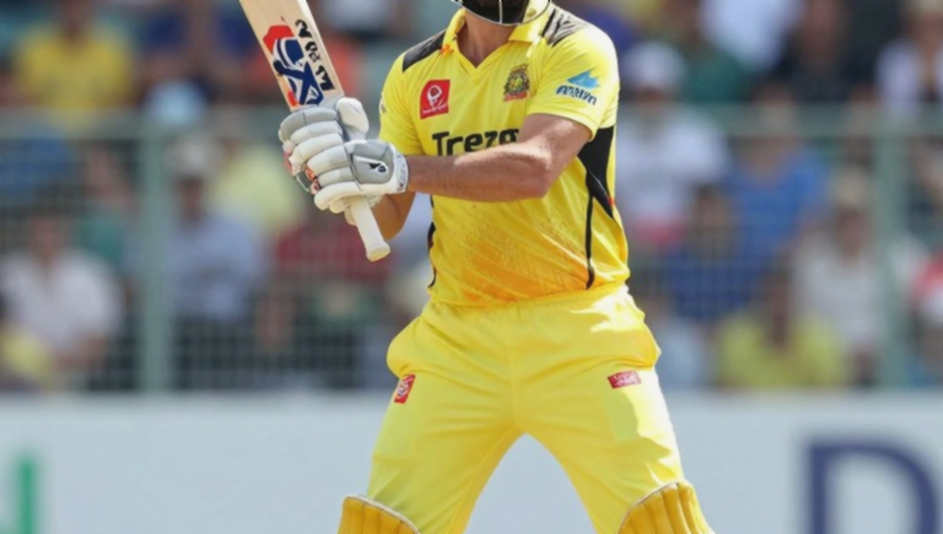
There is no captaincy experiment. Mitchell Santner captains both squads — leadership continuity deliberately preserved in a disrupted squad.
Staggered replacements, not like-for-like
New Zealand have not replaced two batters with two direct substitutes. Henry Nicholls covers games one to three, Dean Foxcroft covers games four and five, and Seifert has been upgraded from a two-match selection to the full series. The hole is being patched over time rather than filled in a single move.
Matt Fisher's extension is the least-discussed but most structurally significant change. Originally named for games four and five only, he is now available across the whole series. Across the two blocks that gives New Zealand seven pace options — Matt Henry, Kyle Jamieson, Jacob Duffy, Blair Tickner, Nathan Smith, Fisher, and Ferguson added in block two — with Santner and Michael Bracewell as the spin pair in both.
The coach described Nicholls as no stranger to this side and noted Foxcroft's recent ODI exposure against West Indies. The language is warm, but it makes no claim that either is a talent equivalent of the men they are covering.
Seifert's expanded workload
The largest single role change in the entire story belongs to Tim Seifert — from a two-match selection to the full five-match series, plus wicketkeeping duties in the second block. For a wicketkeeper-batter, a sudden spike of that kind is a known precursor to soft-tissue breakdowns. Headlines have focused on the two absentees; the doubling of one player's workload is the most under-reported change.
Matt Henry: the unresolved question
One line in the squad release is easy to skim past: Matt Henry assembles with the squad and will be assessed on his readiness to play. That is not logistics; it is a fitness question. In a five-match series, the availability of the frontline new-ball bowler is arguably a larger sporting variable than either batting absentee — and Fisher's extension to the full series reads as insurance against exactly that outcome.
Strong bowling, thin batting
New Zealand's selection response is asymmetric. Lost batting was replaced with batting; no bowler was lost to injury. All four additions — the Seifert upgrade, Nicholls, Foxcroft and Fisher — are cover or expansion, not injury replacement in the bowling department. The squad's risk therefore sits entirely in the batting order.
The pace attack, by contrast, is at or near full strength, with Henry the sole conditional availability. That narrows the competitive gap against India considerably, because a five-match ODI series is frequently decided by bowling discipline through the middle overs.
The second block's inclusion of Clarke, Hay and Kelly also indicates that this series is functioning as a capability test, not only a contest. For a small-population cricket nation, that pipeline exposure matters.
Where the risk actually sits
The largest risk in this story is not in the ODI series at all — it is Ravindra's availability for the Test series. Withdrawing him from the ODIs is a mitigation action; the underlying exposure remains. An untimed shoulder injury can quietly extend beyond the Test window.
The second risk is batting-order instability. Two first-choice batters are out and three different players cover their slots across different matches, which inevitably costs continuity.
The third is the calendar itself. Five ODIs plus a Test series inside one month is the root risk, and the two-block structure is the correct response to it.
What to watch
First, New Zealand's Test squad announcement — whether Ravindra is named will say more about the shoulder than any medical bulletin. Second, Matt Henry's fitness before the first ODI. Third, whether Foxcroft and Kelly both play the final two games, which will reveal whether the second block is a genuine audition or a nominal listing. Fourth, whether Seifert plays all five.

One caveat should be stated plainly: the available information contains no confirmed host venue, no team rankings and no player performance data. Any conclusion about how the series will unfold drawn from this material alone would be unsupported. This is a squad-management and availability story, not a forecast.