
Kabaddi
Kabaddi's Next Test: Bodies, Calendars and the Fight for Control
कबाडी आज व्यावसायिक रूप से मज़बूत है, लेकिन उसकी मुख्य चुनौती मैदान पर नहीं, ढाँचे में है। घने लीग कैलेंडर से खिलाड़ियों पर चोट का बोझ बढ़ रहा है; क्लब और राष्ट्रीय टीम के शिविर अक्सर टकराते हैं; ज़मीनी स्तर पर प्रशिक्षित कोच और चोट-प्रबंधन का अभाव है; और राष्ट्रीय महासंघ से जुड़े समय-समय के विवाद प्रशासनिक अस्थिरता पैदा करते हैं। ईरान जैसी टीमों का उभार भारत की पुरानी बढ़त को चुनौती दे रहा है। समाधान तीन हैं — कैलेंडर में आराम की गारंटी, खिलाड़ियों की सुनी जाने वाली सामूहिक आवाज़, और ज़मीनी ढाँचे में प्रशिक्षण तथा चिकित्सा निवेश।
Kabaddi no longer needs an introduction. A game that began in mud pits now occupies television prime time, drives franchise auctions and produces contracts worth crores. But every boom has a price, and in this sport the price is paid at the intersection of three things: athletes' bodies, their calendar, and the institutions that control both. Kabaddi's next contest is not on the mat. It is in the structure around it — how many matches, how many rest days, whose priority comes first, and whose voice gets heard.
Pro Kabaddi League rewrote the sport's economy. Players who a few years ago balanced a government job with state-level competition are now names that draw bids. Teams, sponsors and broadcasters all run on the same equation: more matches, more inventory, more revenue. That equation makes the sport visible, but it places the cost on the party with the weakest bargaining position — the player.
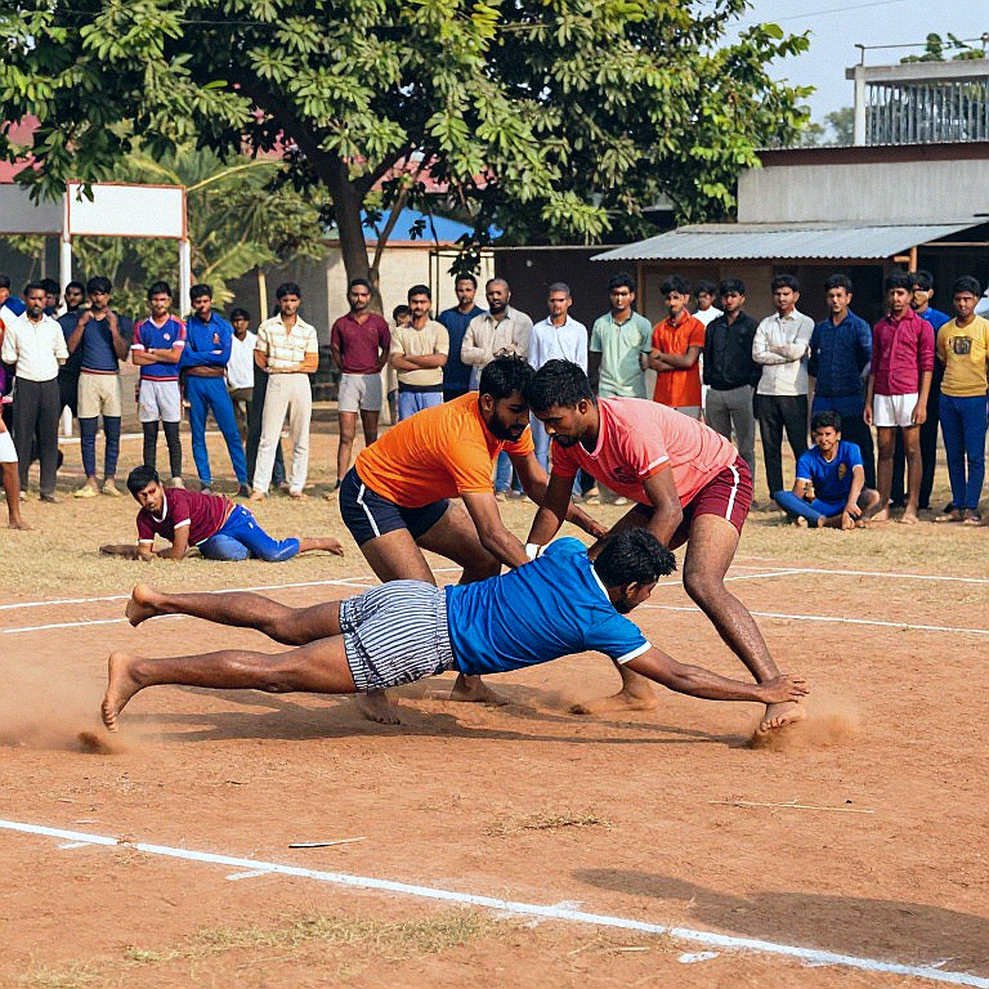
A franchise plays several weeks of near-continuous fixtures, often with two or three days between matches. In kabaddi that gap matters more than in most sports, because this is a contact game: every raid is a collision, every tackle a fall. Rest is not a luxury here; it is the condition of recovery. When the calendar is set by commercial need and recovery becomes an afterthought, injuries stop being accidents and start being expected outcomes.
The raider's body wears fastest. Ankle, knee and shoulder work together and fail together in the same movement. Names like Pardeep Narwal are known for their raiding, but behind that reputation sit thousands of repetitions, and every repetition borrows a little from the body. The question is not whether damage will occur. The question is whether the body will be given a chance to repay the loan.
The defender's story is different. He must go down in every raid, stop an athlete arriving from the opposite direction, and often go down at a bad angle. Defenders of the calibre of Fazel Atrachali do the hardest job in the sport — they are praised when they succeed, and their bodies are charged for it whether they succeed or not.
Every franchise has a physio and a strength staff, but quality is not uniform. States with a deep kabaddi ecosystem offer better rehabilitation; where the sport merely exports talent, the player manages his own body. That inequality surfaces at the end of the season in the injury list, and the same list decides who gets a contract next year and who does not.
Kabaddi's international calendar is thin — the Asian Games, the World Cup, a handful of bilateral series. Thinness is itself the problem. When opportunities are few, each one becomes heavier, and national camps land precisely when a player returns exhausted from league duty. The club-versus-country conflict exists in every professional sport; in kabaddi it is sharper because the pool of elite players on both sides is small.
The national jersey carries real weight in Indian kabaddi. Players place it above league contracts, and that sentiment is convenient for administrators — sacrifice in the country's name can be assumed, while in the league the same rest becomes a contractual term. Until players have a formal collective voice, this imbalance will not correct itself.
Iran's rise is the biggest story in the game. Kabaddi was adopted there systematically — fitness, discipline and a clear defensive school. The result is that India now meets, at every major tournament, a side capable of beating it. That is good news for the sport and a clear warning for the Indian system: an old edge does not hold by itself. It has to be rebuilt in every generation.
Efforts to grow the game beyond South Asia continue, but every new territory meets the same obstacle — the quality of refereeing and coaching. Kabaddi decisions are fast and fine-grained: the line rule, the thirty-second raid, the angle of a tackle. Where those calls lack consistency, confidence in the sport weakens, and the first people to pay for that are new viewers.
India's strength in kabaddi sits in its villages. Akhadas, school tournaments, block and district competitions — that chain keeps producing players. But most links in the chain have no trained coach, no injury protocol, and no reliable record of a player's age or credit. Academies are arriving, but they cannot replace the chain; they are a floor built on top of it.
In recent years teams have invested in video analysis and data — raid patterns, tackle success rates, opponents' habits. That is welcome, but data does not change a player; it only improves a decision. Until equal attention goes to recovery, sleep, nutrition and mental health, the data does only half its work.
Kabaddi's administrative story is less clean than its sporting story. Disputes over federation elections, recognition and sponsorship have surfaced repeatedly, and there have been phases when administrative uncertainty hurt both players and state units. When a sport is growing fast, governance stability is its biggest need — and that is where the shortfall is most visible.
Women's kabaddi took a different road: less coverage, fewer opportunities, but no shortage of competitiveness. The Indian women's team has been strong at Asian level for years, yet the domestic structure has not reached the depth of the men's game. Until a women's league and a proper contract structure exist, half the talent pool will keep going unused.
Kabaddi's greatest asset is its geography. From villages in north India to Iran, Bangladesh and Sri Lanka, the sport speaks to audiences in their own language. Television ratings have already proved that people will watch something other than cricket in prime time. But durable revenue comes from tickets, merchandise, local broadcast rights and grassroots events — not from advertising alone.
Saving kabaddi does not require a miracle. Three things would do: a calendar in which rest is not the first item cut, a players' body that is genuinely heard, and a grassroots structure that pays coaches to be trained and to manage injuries. The benefit of all three will show on the mat — but slowly, because these are investments, not advertisements.
संबंधित खिलाड़ी
अनुशंसित
Surjeet Singh Captain, Naveen Kumar Deputy: The Paper Trail of the 2026 Commonwealth Kabaddi Championship2026-10-28
Pakistan's Last-Minute Withdrawal Derails Inaugural Commonwealth Kabaddi Championship 2026: The 14-to-13 Arithmetic and an Unanswered Question2026-10-22
Surjeet Singh Captain, Naveen Kumar Vice-Captain: Three Unanswered Questions for India Before the Commonwealth Kabaddi Championship 20262026-10-22
Surjeet Singh Captain, Naveen Kumar Vice-Captain: The Real Commonwealth Kabaddi Story Is What the Press Release Left Out2026-10-22
The Honest Column: Where India's Kabaddi Loses in the Arithmetic2026-11-01
अनुशंसित
The Honest Column: Where India's Kabaddi Loses in the Arithmetic2026-11-01
Pakistan's Late Withdrawal Leaves the Commonwealth Kabaddi Championship Without Its Only Real Contest — What the 14-to-13 Math Actually Changes2026-10-22
Commonwealth Kabaddi Championship 2026: Surjeet Singh's Captaincy and the Two Lines in the Release That Cannot Both Be True2026-10-22
From 14 to 13: Pakistan pulls out of Ahmedabad's inaugural Commonwealth kabaddi title, and the question outgrows the draw2026-10-22
Pakistan's Last-Minute Pullout in Ahmedabad: The Bigger Question Is Visas and NOCs, Not Kabaddi2026-10-22