
होमKabaddiThe Real Game of Kabaddi: The 30-Second Raid, Bonus-Line Conditions and Do-or-Die Pressure
Kabaddi
The Real Game of Kabaddi: The 30-Second Raid, Bonus-Line Conditions and Do-or-Die Pressure
कबड्डी में मैच का फैसला स्कोरबोर्ड से नहीं, नियमों की चार परतों से होता है: (1) कैंट — रेड के दौरान लगातार 'कबड्डी' बोलना अनिवार्य, जाप टूटा तो रेड रद्द; (2) बोनस लाइन — गहराई में खींची रेखा पार करने पर 1 अंक, लेकिन केवल तब जब विपक्षी टीम के 6 या अधिक खिलाड़ी कोर्ट पर हों; (3) ऑल आउट — पूरी टीम आउट होने पर विपक्ष को 2 अतिरिक्त अंक और टीम का पूर्ण रिवाइव; (4) डू-ऑर-डाई रेड — लगातार दो खाली रेड के बाद तीसरी रेड में अंक न बनना रेडर के आउट के बराबर। टैकल में अंक सामूहिक रोक पर मिलता है, अकेली झपट्टे पर नहीं। विश्लेषण में वॉल्यूम (कुल रेड अंक) और एफिशिएंसी (सफल रेड प्रतिशत) को अलग रखना ज़रूरी है, वरना खिलाड़ी का मूल्यांकन गलत होता है। स्टैंडर्ड स्टाइल (प्रो कबड्डी लीग, एशियाई खेल) और सर्कल स्टाइल (पंजाब का ग्रामीण सर्किट) के स्कोरिंग नियम अलग हैं, इसलिए दोनों के आंकड़ों की तुलना नहीं की जानी चाहिए।
Kabaddi is routinely dismissed as a 'simple game' — two halves, one raider, seven defenders, and a continuous chant of 'kabaddi-kabaddi'. But the real contest is not fought in these visible actions; it is fought inside the thirty-second window in which a raider must enter the opponent's half, score, and return safely to his own side. A spectator who reads the scoreboard to understand the drift of a match usually stays confused; a spectator who understands the layers of the rules predicts the direction of the contest from the very first raid.
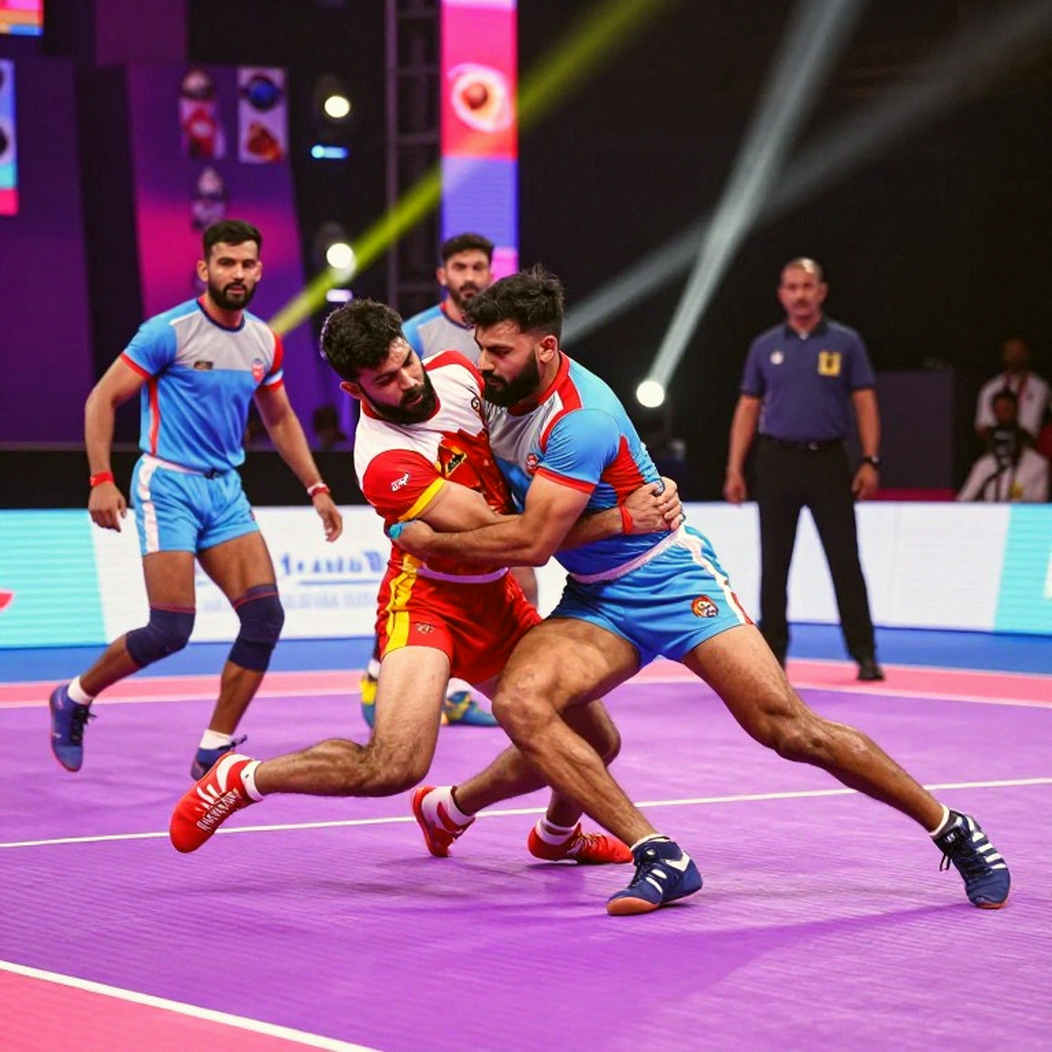
The basic rule of the raid is simple: the attacker enters the opponent's half, touches a defender, and returns within his own boundary. But inside this simplicity sits a strict condition — the cant. Throughout the raid the raider must continuously chant 'kabaddi'. The purpose is to prove he is not inhaling; the moment the chant breaks, the raid is void. This is a physiological rule rather than a technical one. Many raiders make a breathing-management error in the final moments and return empty-handed instead of completing a potential super raid. Coaches hold that cant discipline is no less important than raiding skill.
The second layer is the bonus line. Crossing this line, drawn deep in the opponent's half, earns one point — but only on condition that the defending team has six or more players on court. That condition turns the bonus into a strategic weapon. When the opponent is down to fewer players, the temptation of the bonus line disappears and the raider must fall back on conventional raiding. This is why experienced captains use the bonus not to add points but to break the structure of the defence: the pressure of reaching the bonus line pulls defenders out of their depth, and that opens the space for the raider to escape the tackle.
The third and most decisive layer is the all out. When every player of a side is ruled out, the opponent earns two additional points and the entire team returns to court. This can be called the team-wipe reset. It is both kabaddi's biggest scoring swing and its biggest strategic error. Many matches have seen a ten-to-twelve point lead collapse within a few raids, because an all out does not merely give two points — it brings the opposing team back at full strength. Modern kabaddi therefore treats 'preventing the all out' as a distinct skill: defenders deliberately let a raid go empty rather than attempt a tackle, so that the team does not break.
Within the same structure sits the do-or-die raid. After two consecutive empty raids, the third raid is do-or-die; failing to score is equivalent to the raider being out. This rule binds the tension of the match into a three-raid cycle. Teams now think of raiding in 'counts of three' — the first raid risky, the second safe, and the third carrying the full weight of pressure. Captains often send not their most reliable raider for the third raid but their fastest and most risk-capable one, because in a do-or-die raid there is no meaning left in safe play.
Compared with raiding, the foundation of tackling is collectiveness. A defensive point is earned only when the whole team stops the raider inside its own half. The most common error here is the solo tackle: one defender lunges at the raider, the grip fails, and the raider returns safely with a point. In modern kabaddi, tackle success is decided not by individual bravery but by the disciplined structure of the chain — who makes first contact, who grabs the raider's heel, and who shuts the exit route.
This is where a major technical divide begins — Standard Style versus Circle Style. International events such as the Pro Kabaddi League and the Asian Games are played in Standard Style, while the rural Punjab circuit follows Circle Style. The scoring rules and the geometry of the field differ. Coverage repeatedly confuses the two: comparing figures from a rural tournament with league figures, or treating Circle Style performance as an international benchmark. For technical analysis this distinction is fundamental.
At the level of statistics, the commonest deception is volume versus efficiency. A raider's total raid points can look impressive, but they do not answer how many raids he took to earn them — that is, his successful raid percentage. A raider who brings 300 points from 300 raids and another who brings 250 from 150 raids may look similar in raw totals, yet the second is far more efficient and gives his team more return at lower risk. Similarly, in defence, counting only tackle points is insufficient; tackle success rate and the cost of failed tackles must be read together.
The biggest structural risk in team building is dependence on a single star raider. When a team's entire scoring burden rests on one player, the opposing strategy becomes simple — concentrate the tackle on him, trap him in a do-or-die raid, and if he is injured the whole attack collapses. Injury deserves separate attention, because kabaddi involves continuous physical contact and the absence of a leading raider can change the direction of a season. Balanced teams, by contrast, stand on three or four raiding options and a strong defensive core.
At the competitive level it is essential to understand that the logic of the domestic league and the international layer are different. In the league, franchise rhythm, auction constraints and the fatigue of a long season are decisive; in international tournaments, form and experience in a short span of matches carry greater weight. The same player may appear in a different role in the two settings because team structure and expectations change. Merging these two layers into one is the most common analytical error.
Kabaddi's most notable industrial contribution is its model — the combination of franchise, auction and prime-time broadcast. The same framework was later replicated by badminton, wrestling, volleyball and table tennis leagues. This cross-league demonstration effect is kabaddi's most transferable insight: it proved that even under cricket's shadow, non-cricket sports can stand in the domestic market, provided the format is short, the broadcast clean, and regional identity strong.
The model also has two major weaknesses. First, broadcast concentration. When a league's revenue and audience reach depend mainly on a single broadcaster, bargaining power shifts to that broadcaster and the league's financial stability becomes fragile. Second, the absence of a women's league. This is not merely a social question but a long-term talent-pipeline risk: without a visible professional platform for half the population, the sport loses a large share of its talent.
At the administrative level, kabaddi's challenges resemble those of other South Asian sports. Federation management, athlete protection, the anti-doping system, standardisation of officiating and age disputes are all issues that rarely make headlines but can produce concrete outcomes such as event cancellations or player eligibility bans. Incentives such as reservation in government jobs and the Arjuna Award shape players' career decisions and directly affect the flow of talent.
At the level of public narrative, kabaddi coverage repeats one pattern again and again — the search for the 'next star'. After one good season a young raider is immediately anointed the next great player. The problem is sample size: performance across a handful of matches is no proof of long-term stability, and metrics such as successful raid percentage become meaningful only over a full season. When expectations outrun the underlying numbers, disappointment follows in the same proportion.
The essence of all this is that kabaddi analysis does not begin with the scoreboard. It begins with cant discipline, the six-player condition on the bonus line, the two-point reset of the all out, and the third-raid cycle of do-or-die. The team that converts these four into strategy — risk management in the raid, collectiveness in defence, and limits on star dependence — is the team that pulls ahead over a long season. Everything else is the noise of numbers, and reading that noise without an understanding of the rules is the greatest injustice one can do to kabaddi.

संबंधित खिलाड़ी
अनुशंसित
Pakistan's Last-Minute Withdrawal Derails Inaugural Commonwealth Kabaddi Championship 2026: The 14-to-13 Arithmetic and an Unanswered Question2026-10-22
Pakistan's Last-Minute Pullout in Ahmedabad: The Bigger Question Is Visas and NOCs, Not Kabaddi2026-10-22
Kabaddi's Next Test: Bodies, Calendars and the Fight for Control2026-11-01
Commonwealth Kabaddi Championship 2026, Day 1: The Table Was Built by Score Difference, Not by Matches2026-10-24
अनुशंसित
Kabaddi's Next Test: Bodies, Calendars and the Fight for Control2026-11-01
Ahmedabad's 62-Match Sheet: The Column Where Iran's Name Was Missing2026-10-22
The Jakarta File Reopened: Auditing 18-27, and Kabaddi's Two-Code Border Dispute2026-11-01
Commonwealth Kabaddi Championship 2026: The Empty Broadcast Box and the Real CWG 2030 Agenda2026-10-30
The Real Game of Kabaddi: The 30-Second Raid, Bonus-Line Conditions and Do-or-Die Pressure2026-11-03